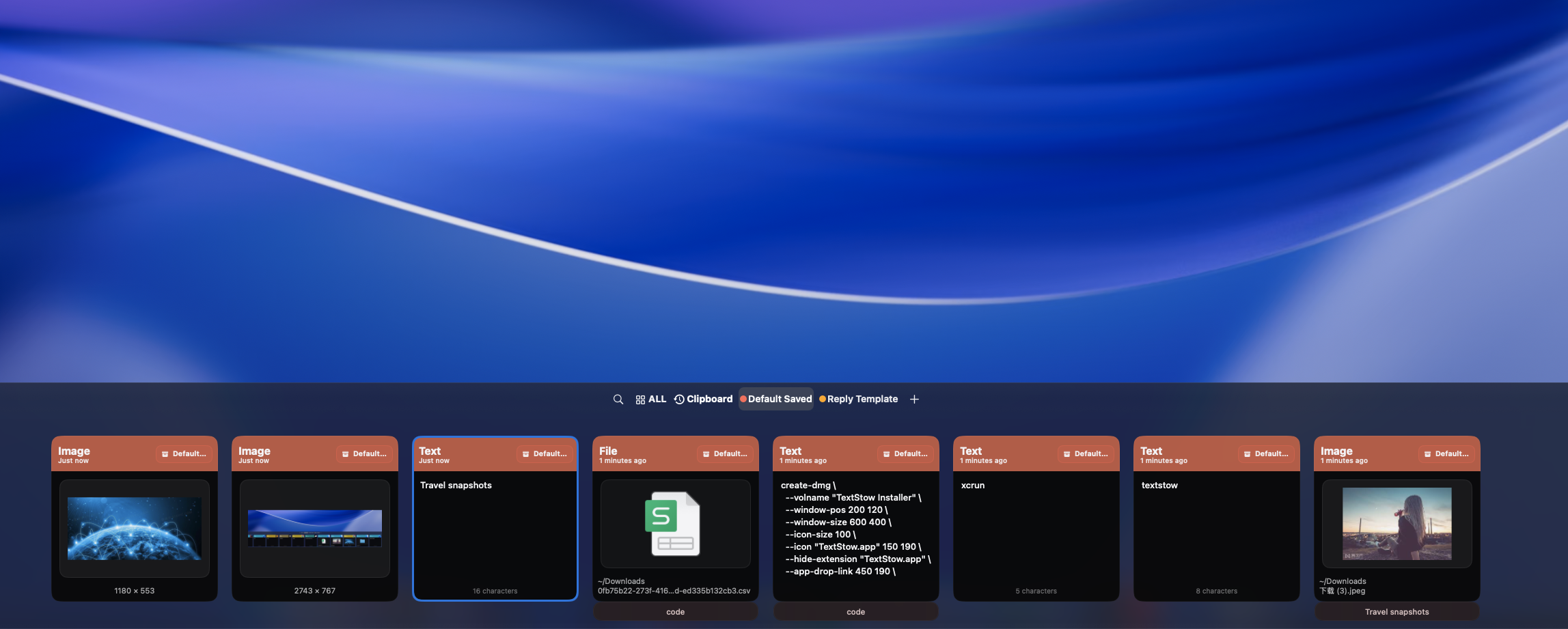
Quick Answer
Clipboard history helps recover what you copied recently. Content bookmarks save important text, images, and files permanently for reuse.
TextStow focuses on the Mac copy-paste moments that usually disappear from view: clipboard history, saved snippets, text cleaning, full-text search, and local storage. That combination makes it useful for people who copy information throughout the day and need to reuse it without changing their main app.
The Workflow Problem
Many users treat clipboard history as a messy snippet library, but old history is often temporary, noisy, and subject to cleanup rules.
The cost is rarely one dramatic failure. It is the repeated 30-second search, the lost command, the broken PDF paragraph, the reply template you rewrite again, and the context switch to another notes app or browser tab.
What macOS Does Not Solve by Itself
macOS has neither a history layer nor a permanent clipboard-based bookmark layer.
The built-in clipboard is fast, but it is intentionally temporary. Once you copy something new, the previous item is gone unless another app has already captured it. That is why a dedicated clipboard manager is a practical upgrade instead of a cosmetic utility.
How TextStow Handles It
Use TextStow history for automatic capture, then convert high-value clips into bookmarks with titles, categories, and tags.
Because TextStow runs from the menu bar, the workflow stays close to the place where copying already happens. Open the panel, search a phrase, filter the result, bookmark content that should become permanent, or run a text processing action before pasting.
Why This Converts Into Real Time Saved
Separating history from bookmarks keeps the tool fast for recovery and organized for long-term reuse.
For high-frequency copy-paste work, the win is not just speed. It is confidence that the thing you copied earlier is still recoverable, searchable, and reusable without sending private clipboard content to a cloud service.